- The Thriving Moose Newsletter
- Posts
- Quiet Power, Real Freedom: A 14-Day Loop to Rebuild Identity and Optionality
Quiet Power, Real Freedom: A 14-Day Loop to Rebuild Identity and Optionality
Discover a practical, introvert-friendly system that pairs a minimum viable identity with fast proof behaviours and low-arousal experiments to help you break free from the paycheck trap while you are still employed.

Paul Rise
September 11, 2025
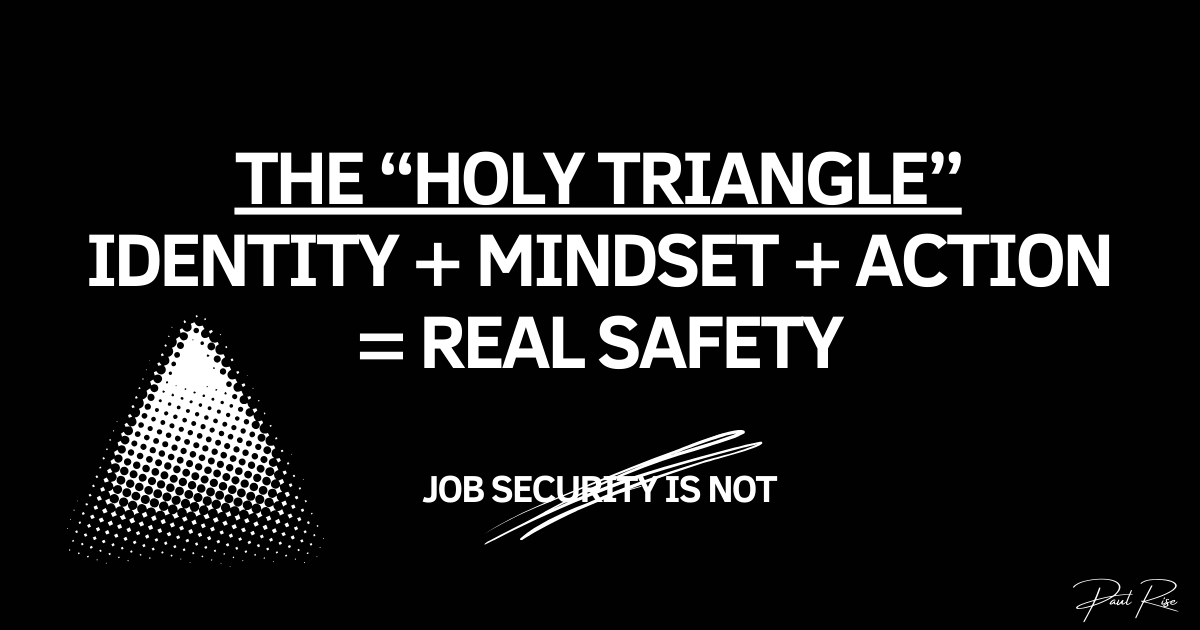
Most people mistake job security for safety. They cling to a monthly paycheck, a title, and the predictable comfort of meetings and calendars. Meanwhile, their energy, creativity, and options quietly shrink. That isn’t security; it’s concentration risk—one boss, one income stream, one identity.
What follows is a practical way out (also, introvert-friendly). Think of it as a triangle with three sides that support each other: identity, mindset, and aligned action.
No pep talks, no “go big or go home.” Just quiet power applied consistently.
The false sense of job security (and how it blocks you)
Job security looks like stability from the outside. On the inside, it’s dependency. If one decision above your pay grade changes, everything changes for you.
Your nervous system loves the predictable rhythm—direct deposit hits on the 27th, the 10 a.m. standup always starts late—and that predictability feels like safety.
But there’s a bill you’re paying for that feeling: a slow-burn cost that compounds as burnout, loss of autonomy, and stalled growth.
Neuroscience explains the trap. Your amygdala overestimates immediate threats (uncertainty, change, possible disapproval) and underestimates slow-moving risks (chronic stress, skill atrophy). Status-quo bias does the rest.
For introverts, the workplace “bubble” often doubles as a social shield; it filters noise, reduces stimulation, and provides a script. But that same shield blocks the small experiments that would rebuild confidence and optionality.
I coached a mid-career manager who kept saying, “The pay is good; I’m lucky.” Two years later, he wasn’t sleeping, wasn’t training, and his creativity was a memory. When restructuring came, his “security” vanished in a 12-minute meeting.
The danger wasn’t quitting; it was staying.
If you’re honest, you can already name the costs you’re paying to keep the illusion alive: the energy that never fully resets on weekends, the ideas you don’t ship, the choices you don’t get to make. Once you see those costs clearly, the triangle starts to make sense.
Is mindset shifting enough? Why mindset-only fails
Mindset work is essential. Without it, no identity and no action can indeed happen. But mindset without behavior feedback is brittle.
You can read, journal, and reframe all you like; if nothing in your world forces an update, your brain has no reason to remap. Durable change needs prediction errors—moments when action contradicts an old belief and your brain must revise the model.
This is why “I’ll fix my mindset first, then I’ll act” keeps people stuck. It feels productive (you’re learning!), but the quiet consequence is self-trust erosion: you know better yet don’t do differently. That hits hard. It hit me hard when I was drained and stuck in high-paying but unfulfilling fixed employment (before breaking free and flying solo).
For introverts, the trap is even easier to fall into because internal work feels safe and generative. The fix isn’t louder hustle; it’s smaller, truer experiments soon—actions you can take within forty-eight hours that let your nervous system discover, “Oh… I can do this, and I’m still safe.”
Pair every belief shift with a proof behaviour. Reframe “Outreach is scary” into “Outreach is service,” then send one thoughtful DM to help a real person this week. Let action do the teaching.
Identity: the sturdy container for everything else
Mindset is what you think. Identity is who you are (now) and who you want to become (future). The story about yourself that you tell about yourself. Ideally, your “now” identity should sync with your “future” identity. You are a fortunate person if who you want to become aligns with who you are today. But if not, don’t despair. Most people lack clarity about their identity.
Worse, who they are today is far from who they truly are and who they want to become because the new “persona” they (subconsciously) roleplay is the result of an effort to conform and fit in (call it social or environmental conditioning).
A clear identity is a must-have in the process of breaking free from burnout, stuckness, fear and hopelessness towards a life and work on your terms, honouring who you are, your values and priorities.
Identity acts like a container: it directs your attention, influences which opportunities feel salient, and quietly governs what you do when no one’s watching.
If your current self-schema is “I’m an employee who needs approval,” your system will filter for safety and consensus. If your emerging self-schema is “I’m a quiet-power creator who solves meaningful problems,” your attention shifts automatically: you protect deep-work blocks, make small offers, and say no to energy drains.
Neuroscience backs this up—identity shapes salience, salience drives dopamine, and dopamine fuels intention and action.
But identity doesn’t get strong by declaring it; it gets strong through evidence. No proofs, no stability.
Here’s a simple way to design yours (I use a more sophisticated method in my coaching if interested). But the below exercise can be a good starting point.
Two lines are enough: “I’m becoming a [guide/craftsman/strategist] who builds [specific value] for [specific people] in a calm, focused way.”
Then choose three proofs you’ll repeat weekly: ship one tiny artefact (physical or digital), draw one boundary that protects your energy, and do one value-forward outreach.
Think reps, not declarations. Identity cosplay (“I’m a solopreneur now!”) collapses at the first sign of friction; empirical identity—built from small proofs—doesn’t.
Which comes first: identity or mindset?
There’s no single correct starting point. Different nervous systems need different doors.
If you’re overwhelmed and disconnected from any vision, begin with mindset. Lower anxiety, create quick cognitive wins, and clear fog. But don’t stop there. Tether each reframe to a proof action and a tiny identity cue—rewrite your bio line, rename a folder, change the label on your calendar block from “admin” to “craft.” Without these anchors, mindset work stays abstract and risks reinforcing the old story: “I’m broken; I must fix my mindset.”
If you feel a strong pull toward a future self, begin with identity. Claim a minimum viable identity and collect three proofs this week. Expect imposter spikes (that’s your system noticing novelty). Then do mindset work to reframe the beliefs that try to pull you back. Without proof behaviours, identity becomes aspirational cosplay—fun, but fragile.
The most realistic path for enduring change is to run identity and mindset side-by-side. Don’t overthink the order—pick one lever to pull today and make sure the other is close behind.
The “holy” triangle: where identity and mindset meet aligned action
Most high-achieving, freedom-seeking mid-career professionals stay stuck and never make the leap (that their souls and minds scream about inside them) despite doing their homework: crafting a crystal-clear, strong identity and making mindset shifts. That’s because they lack the third essential ingredient: aligned action.
Aligned action is small, true, and directional. It doesn’t need to be dramatic to matter. You’re aiming for a rhythm that your system can sustain:
enough challenge to create growth signals
not so much arousal that you torch your capacity
This is how you can sustainably work on all three levers (identity, mindset, action).
Rotate three kinds of moves.
Do calibration to learn (a 30–60 minute experiment that answers one question).
Do building to create assets and skills (a checklist, a sample, a case note, a micro-portfolio piece).
Do exposure to share value in public or semi-public (a post, a thoughtful DM, a short Loom for one person).
For introverts, keep arousal low: choose asynchronous over live, written before video, smaller rooms before big ones. Exposure doesn’t need volume; it requires precision and consistency.
Here’s the deeper “job security”reframe: instead of “safety = paycheck,” try “safety = cash buffer + pipeline seeds.”
A buffer calms your nervous system.
Seeds increase optionality.
That’s how you diversify your risk in life, the way you would in a portfolio.
Put a quiet-power cadence on your calendar: two protected deep-work blocks a week, one tiny thing shipped, one value-forward outreach, one deliberate learning session, and one real rest ritual. If it isn’t scheduled, it’s a wish.
A 14-day loop you can run immediately
Think of the next two weeks as practice, not performance.
On day one, write your two-line identity and choose a single belief to reframe.
On day two, design a short calibration experiment you can run in under an hour—something that will teach you about the problem you want to solve or the people you want to help.
On day three, run it and write down one learning and one next step.
On day four, publish a tiny artefact that captures what you learned—a short post, a paragraph, or a quiet Loom sent to one person.
On day five, turn that learning into a permissionless asset: a checklist, a template, a resource someone else can use.
On day six, share it privately with someone who would benefit.
On day seven, rest and review: notice self-trust, energy, wins, and what you’ll repeat.
In the second week, repeat the same cadence with a new micro-experiment. Score what matters, not vanity metrics: things shipped, people helped, energy levels, and the number of opportunities showing up. These are the leading indicators of true security.
The usual objections (and what to do instead)
“I don’t have time.” You don’t need three free hours; you need a smaller unit. Twenty-five minutes tomorrow is enough to run a calibration step. Shrink the work until it fits.
“I don’t have money.” Differentiate investment from expense. A modest tool that saves two hours a week or a short course that upgrades a bottleneck is risk-mitigating, not extravagant. Track simple ROI: time saved multiplied by your hourly value.
“What if I fail?” Use graded exposure and reversible moves. You are not betting the farm; you’re buying information. After every experiment, ask, “What did I learn that I can reuse?” When learning becomes an asset, failure turns into inventory.
“I’m not extroverted.” Perfect. You don’t need to be loud; you need to be regular. Asynchronous channels, written first, thoughtful one-to-one value beats broadcasting to strangers.
“What if I get fired if I start posting?” Share principles and problems, not confidential details. Speak from your craft, not your company. Meanwhile, build your buffer and plant seeds before any leap. I can’t stress the latter enough: exit plan + financial buffer + a pipeline.
Closing this loop
Job security kept you safe once. Now it keeps you stuck.
True safety is something you build: a sturdier identity, a cleaner mindset, and a rhythm of aligned actions that widen your options.
I recommend running the 14-day loop twice. Watch your self-trust climb and your opportunities multiply. That quiet, steady feeling you’re after—that’s security.
If you want a co-pilot, I’ll help you design your minimum viable identity, the 5 must-do mindset shifts, and a 30-day action system that fits your nervous system (whether extroverted or introverted) and your real life.
You don’t need louder. You need aligned. You’ve got this.
We will explore the barriers that hold you back from transitioning from burnout, stuckness, and fear to freedom, resilience, impact, and a life and work that is meaningful, purposeful, and enjoyable.
If you are not ready for that yet, it's okay. You are in a safe space here, and you are already on a path towards freedom and meaning. You’ve not landed here by accident or luck. Trust me.
Reply