- The Thriving Moose Newsletter
- Posts
- Why Your Plan Isn’t the Problem - Here's The Missing Piece in Your Solo Transition
Why Your Plan Isn’t the Problem - Here's The Missing Piece in Your Solo Transition
Discover how to build the foundation of your solo journey on solid ground by focusing on the 6 things that bring real proof and momentum without burning you out.

Paul Rise
January 15, 2026
People who want to go solo say they want freedom. But usually, that’s not the full truth. What they really want is certainty - before they start building their solo path.
They want to know:
Will this actually work?
Will I make money?
Will I regret it?
Will I embarrass myself?
Will I lose the stability I have now?
So they wait. They research more. They refine more. They “prepare.” They build increasingly complicated systems in their head and call it strategy.
But nothing actually moves. And that’s the hard part to admit:
You cannot properly evaluate a path you haven’t walked. You can only judge the path you’re actually on.
Which means the only real way to turn fog into clarity… is proof. Not motivational proof.
Not “I feel ready now” proof. Real proof. Real-world proof.
Today, I am going to show you how to build your solo path on the side with proof. I will explain how the 7-Day Momentum Builder framework works.
The goal is not to make you a full-time solopreneur in one week. That’s unrealistic. The goal is to help you start building your solo path on the side, while keeping your job, so you can gather evidence without panic.
Why so many people get stuck before they even begin
Most aspiring solopreneurs do not get stuck because they lack talent. They get stuck because they treat the early stage like it needs to look polished, complete, and serious from day one.
So they start trying to build:
complicated systems
complex frameworks
fancy funnels
And yes, it looks impressive. But a lot of the time, it’s just avoidance wearing expensive clothes.
Because when you’re building a funnel, or tweaking your branding, or perfecting your framework, you do not have to face the real thing yet:
A real person saying yes. Or no.
That’s what makes it uncomfortable.
Your brain prefers complexity because complexity feels safer. It feels private. It feels controlled. It delays exposure. It protects you from judgment.
Psychologically, this is very common. When uncertainty rises, people often increase planning to calm their anxiety.
The problem? Planning does not remove uncertainty. Action does.
Or to borrow a simple physics truth: you cannot steer a parked car. You need movement first. Then direction.
Why calm momentum beats rushed intensity
Momentum is not the same as speed. Momentum is steady movement with feedback.
That’s why this framework is built around small steps and consistently executed micro-experiments.
Because micro-experiments do something that big plans never can: they turn imagined fear into measurable data. And that changes everything.
A micro-experiment is small enough that your nervous system does not freak out… but real enough that it gives you proof. And once you have proof, things start changing fast.
Proof lowers fear.
Proof builds confidence.
Proof makes the next step clearer.
That’s why this is not about hype. It’s about evidence.
The six things that make the solo path start feeling real
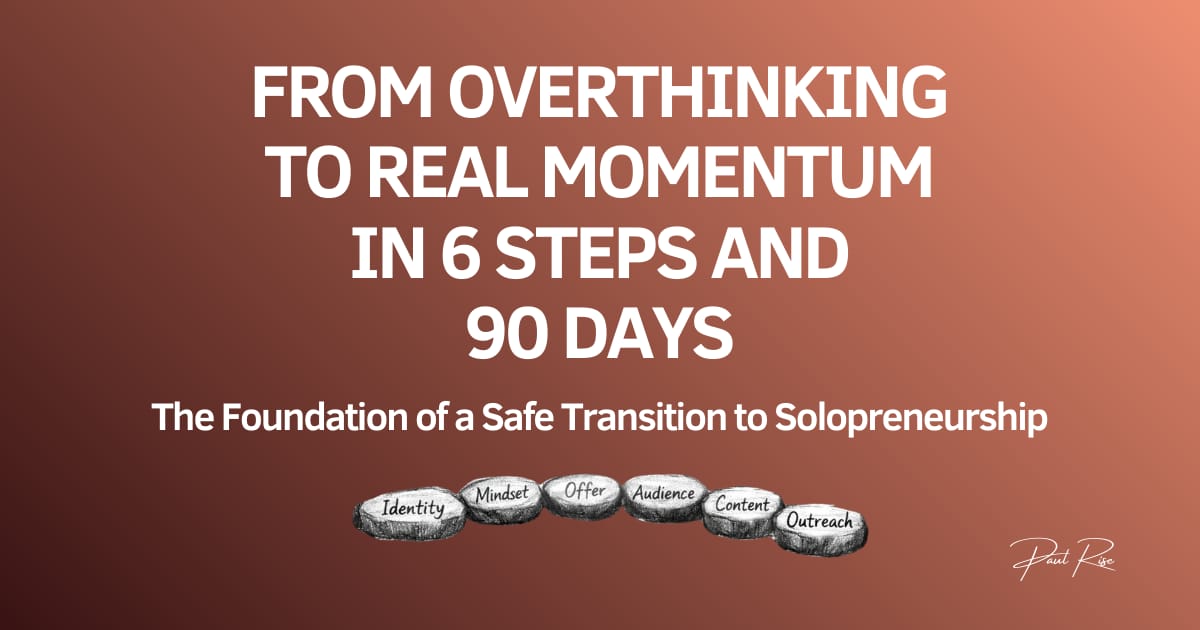
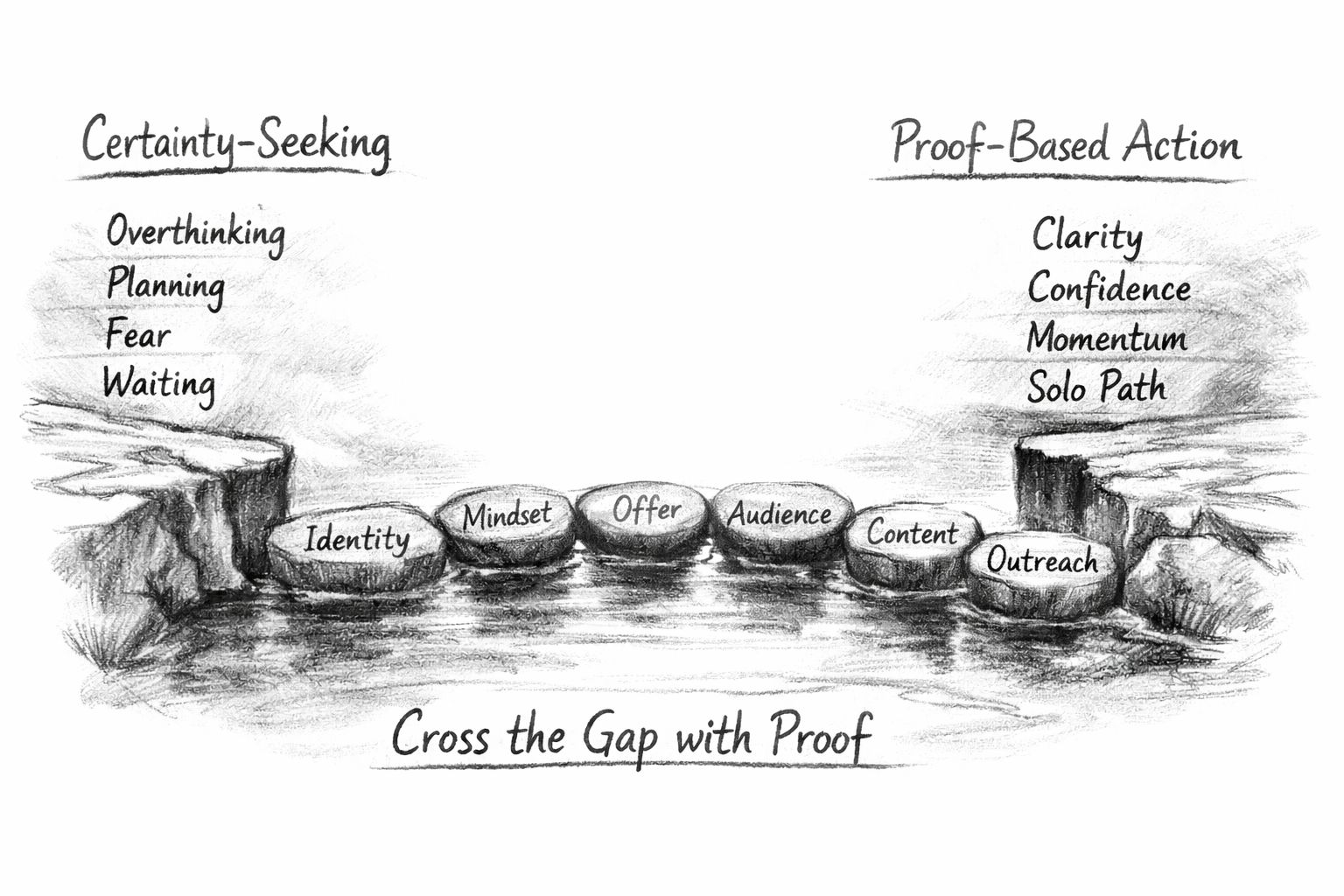
This is the 6-part foundation to focus on when trying to go solo, as it creates traction without pushing you into burnout.
1. Identity–Offer Match
Most pre-solopreneurs do not struggle because selling is hard. They struggle because their offer still does not feel like them.
And when there’s a mismatch, you can feel it immediately.
You procrastinate.
You keep pivoting.
You avoid outreach.
You rewrite your positioning over and over again.
But when the offer fits, something clicks. You show up more naturally. You explain what you do more clearly. You stop sounding forced. You stop draining yourself every time you talk about your work.
Your offer is not just a business choice. It is also an identity choice.
That’s the first step: making sure you have a clear, strong identity that guides you in choosing the right offer for your solo journey.
Experience shows that most people continue their corporate identity well into their solo journey. The most obvious thing to do is to keep doing the same work you did in corporate, now in a different “solo suit”. I did that myself when I started out.
I had clients as a marketing consultant, but it all felt off, and week by week, it started to feel forced. I didn’t quite enjoy what I was doing (again…), and each step felt heavy.
I simply continued my corporate marketing identity as a solopreneur. Same identity, same role, same work, same mindset.
Then, I went back to the drawing board. I asked myself 3 questions:
who do I want to become (and also, who I DON’T want to become)
what exactly do I want to do as a solopreneur (and also, what I DON’T want)
how do I want to live (or what kind of life do I want my solo path to support in terms of energy, time, location, pace, autonomy, people, priorities)
That’s a blueprint for your identity. And it’s no theoretical “feel good” stuff. It’s 100% practical because, from that identity flow, your values and priorities emerge.
And based on all that (identity, values, priorities), you can choose the most suitable offer as a solopreneur.
In my case, it was content writing, as I love writing and content has always been the thing I enjoy most (and I am pretty good at it).
From that place, I then pivoted to coaching while also leveraging my writing skills and passion. 100% fit.
2. Mindset unblockers — fear in disguise
Most blocks are not logical. They are protective. Fear rarely walks in and says, “Hi, I’m fear.”
It shows up as perfectionism.
As procrastination.
As endless research.
As risk aversion.
As “I just need more clarity first.”
The goal is not to eliminate fear. That’s not realistic.
The goal is to reduce the threat by making the next step smaller, safer, and more structured.
Your brain asks for safety through certainty. But you can give it safety through structure and proof instead.
Mindset is the second foundational pillar of solopreneurship (identity is the first one).
It’s how you approach things in life, work, and business. If your mindset is rooted in outdated software, you will constantly hit dead ends. I call them blockages.
Here’s what an obsolete mindset looks like:
You’ve tried your best to do what it takes to go solo. Nothing worked out.
You came up with new ideas to try. None of them worked out, either.
You are now stuck because you literally (your words) “don’t know what to do”.
That’s just your mindset requiring an update. Think of it as a mental map. That map shows you how things work and how to navigate life, work, business (and the world in general).
Without updating that mental map. You are not going to go anywhere far.
Updating your mental map means one thing: reframing.
It’s about reframing all the blockers that kept you stuck for good (fear, procrastination, perfectionism, money scripts). From limiting to expanding.
Based on experience, a stuck pre-solopreneur usually has all the blockers I mentioned above (to a certain degree). But one of them is the dominant one. The one that does the most harm and keeps you stuck for good.
Mindset work is a reconditioning process (often a long one). The goal now is not to “fix you” or make you “more positive.”
The goal now is to identify whether any mindset blocker is quietly driving your decisions (and keeping you in preparation mode, perfectionism, or avoidance).
3. Minimum Viable Offer — your proof engine
Given your identity is clear and your mindset updated, you are good to go. Really. Nothing is stopping you from going solo and building a successful one-person business. The rest is strategy, tactics, and action. And this is the starting point: a Minimum Viable Offer (MVO). Let me explain.
At the beginning, you do not need a polished signature offer. You need a simple starter offer that you can validate quickly.
Your Minimum Viable Offer should be:
simple
clear
practical
quick
low-risk
Because early on, the goal is not scale. The goal is signal. You’re not trying to prove that you’ve built the perfect business. You’re trying to prove that someone wants what you do. That’s a very different game.
And philosophically, it matters too: this is humility in action. You stop pretending you already know the perfect path.
You test.
You learn.
You adjust.
Here are the 5 elements of a strong MVO
One buyer (a narrow slice you already understand from your career)
One painful problem (happening now, not “someday”)
One crisp promise (one sentence, no commas)
One clear deliverable (what they receive, tangibly)
One proof metric (what improves, or what decision becomes easy)
The minimum viable offer is not meant to be your final business after 6, 12, or 24 months.
It’s meant to be your first proof engine—small enough to ship, clear enough to sell, and structured enough to deliver results fast.
4. Audience Reality Check
A lot of people say, “I can help anyone.” That is never true. And it always creates burnout.
Because when your audience is vague, your content becomes vague. And when your content becomes vague, your outreach feels awkward. And when your outreach feels awkward, you avoid it.
So this is not just about niche clarity. It is about emotional relief.
When you know exactly who you are helping, everything gets lighter.
You stop forcing creativity.
You stop overexplaining.
You stop trying to sound smart to everyone.
You start speaking directly to a real problem for a real person. And that feels better.
A strong audience is not “big.” A strong audience is:
reachable,
motivated,
specific enough
And your offer is not “what you can do.” Your offer is a promise that matters to a specific buyer right now.
Audience determines:
what feels urgent vs “nice to have”
what results count as proof
what a low-risk first step looks like
what price feels fair
what words make them immediately say, “That’s me”
5. A content system that does not consume you
A Minimum Viable Offer (with a perfect match to a specific audience) is the first part of the system you must use to build your solo path on the side (while still employed) and gather proof (so you can then decide when and if to transition to full-time solopreneurship).
The system’s second part is content (my favourite part). And here’s what most pre-solopreneurs miss:
Content should support your offer. Not your ego. Not vanity metrics. Not the need to “stay visible.”
Pick one place your buyers already spend time (often LinkedIn). Don’t start on more than one platform or social media platform (pick one, or risk burnout).
Then write your audience in one clean line (you should have this by now, if you did the Audience Reality Check):
“I help [role] in [context] with [problem happening now].”
If this line is vague, your posts will be ambiguous. And vague does not convert.
A simple content system usually wins.
A sustainable rhythm (so you don’t burn out and give up quickly).
Clear themes tied to your offer (no need to be super creative)
One useful idea per post (focus on it and stay on point)
A calm CTA that opens conversations (not selling or pitching)
That’s enough. That’s how trust gets built without content turning into another full-time job.
6. An outreach system that actually leads to money
Outreach is the real game-changer. It’s the 3rd part of your going-solo system.
This is also the part many people resist. Because they hear “outreach” and immediately think: pushy, awkward, salesy. But salesy is not outreach. Salesy is pressure without permission.
Good outreach is different.
It is a conversation.
It is relevance.
It is curiosity.
It is respect.
It is knowing what to say, how to say it, what to avoid, and how to handle friction without spiralling into self-doubt.
And this is where the real validation happens. This is where interest turns into leads. And where leads turn into clients.
Think of it this way (people say this helps them really comprehend what outreach and content are about):
Content builds trust in public. Outreach builds trust in private.
If you rely on content alone, you will often get:
likes without leads
“great post” without conversations
visibility without clients
Outreach is what turns attention into real proof: replies, calls, and paid first steps.
Your next step does not need to be dramatic
If you are building your solo path right now (or trying to build it but struggling), do this today:
Pick one outcome you could realistically deliver in 7 days.
Message 5 people who are likely to want that outcome.
Ask one clean question that helps validate the pain.
Track proof, not feelings.
That’s it.
Sounds uncomfortable? It should. Because if it sounds easy and familiar, it’s a sign you are still stuck in your usual action zone (not expanding into the solo path you so vividly dream of doing).
If fear and uncertainty hit you hard (and stop you from taking the tiniest action towards building your solo path), read this:
You do not need certainty to begin. You need movement so you can learn. Because you will never know by standing still.
An open invitation
If you’re reading this, you are probably not looking for inspiration or motivation (they never show up when you need them the most).
You are looking for a new rhythm. You do not need a 47-page plan for going solo. You need one focused offer, three posts a week, and ten warm conversations a week for the next 12 weeks (that’s 3 months or 90 days).
That’s it. The rest is often noise dressed up as nuance.
That is what my 7-Day Momentum Builder is about.
It is a short coaching and activation program — seven days from start to finish — designed to help you:
start building your solo path while keeping your day job a bit longer
gather real proof that your work works
move toward full-time solopreneurship with more clarity, calm, and confidence
Not through chaos. Not through drama. But through evidence.
In just 7 days of focused work, you gain clarity and begin taking the right actions to build your solo path.
Most people then build meaningful momentum within 90 days. Some do it faster. Some take a bit longer. That part is normal.
What matters is this:
There is no perfect timing. There is only the timing that feels safe enough to move, with proof.
Not just hope. Not just “I think I’m ready.” Because that is not a plan.
No more:
“I’ll do it when I feel ready.”
“Maybe next month.”
“I’ll start in January.”
“Maybe next year.”
No more wasting years in hesitation. No more regret quietly building in the background. No more telling yourself it is too late because of age, time, energy, responsibilities, or life stage.
I’ve been through that myself and know how it feels. I don’t want that for you or anyone else. Because I know there’s another way, and I actually followed that way. And here I am today.
I’m not special (really far from that). Or talented. I just did what I had to do to go solo and build my one-person coaching business without blowing up my life.
Here’s the invitation.
You have two ways to claim your 7-Day Momentum Builder spot:
or
Bring your fear and your goals; I’ll bring the roadmap.
The call is 100% free. No strings attached, no obligation to anything. It’s a casual virtual coffee to share our stories and see if we are a fit (if not, all good; you leave with my insights and instant stress relief).
Reply